





WATER REPELLENTS
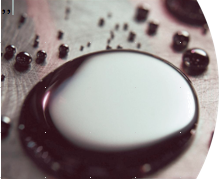 Clues for keeping water out
Moisture is the primary cause of almost all damage observed in building materials. Since many building materials have porous surfaces, moisture and dissolved pollutants penetrate these pores via capillary suction. This situation causes deterioration on reinforced concrete steel bars, salt attacks, or freeze-thaw deformation.
When moisture penetration is hindered, damages to materials decrease significantly.
So, how is moisture penetration hindered?
With water repellents, also known as “Hydrophobation,” utilizing PROTECTOSIL® structure protection products can yield outstanding results. PROTECTOSIL® water repellent products penetrate directly into the surface. Thus, water is kept out while water vapor permeability (breathability) is maintained.
Deep hydrophobation for the most suitable protection
PROTECTOSIL® water repellent molecules are smaller than the surface pores.
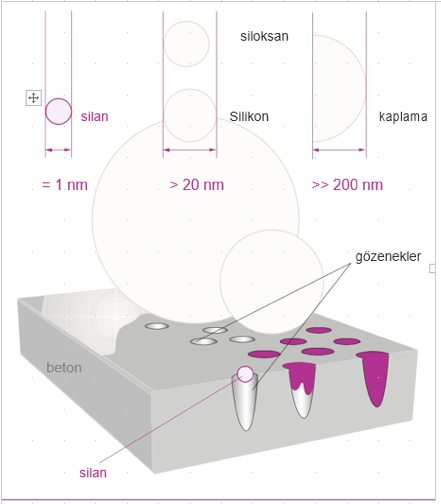
Considering this small size and low viscosity, water-repellent molecules penetrate deep into structure materials and chemically react with the inner pore walls. While external water penetration is hindered, water vapor can still pass through the pores, allowing the structure to breathe.
There are two main advantages to deep penetration protection. UV light and mechanical effects do not damage the protection. Silicones and siloxanes are typically larger than 20nm, so they cannot penetrate easily and are susceptible to damage caused by environmental stress.
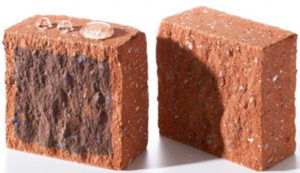
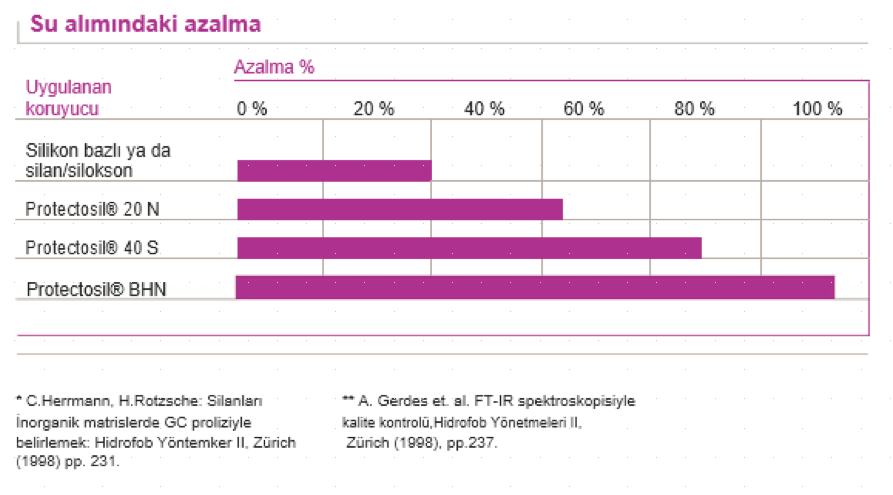
PROTECTOSIL® hydrophobic products create a deep barrier against water. The efficiency of PROTECTOSIL® products is not determined merely by the beading effect on the surface, but by the reduction in water absorption. Their non-destructive effects can be tested on existing structures using Karstens (or Rilem) tubes. Using a core drill with water-based ink is another test method to determine the depth of penetration.
 |
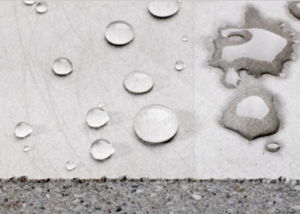 |
Success of water-repellent products on surfaces exposed to high traffic
The water penetration level into concrete was measured before and ten years after being exposed to high traffic. The higher the decrease in water penetration level, the better the surface protection over 10 years.
PRODUCTS
- PROTECTOSIL® 008: Suitable for exterior concrete, zero-VOC, durable against frost, and highly reactive.
- PROTECTOSIL® 009: Zero-VOC water repellent, durable against frost. Suitable for concrete and other porous mineral structural surfaces with excellent beading effect.
- PROTECTOSIL® 100: Suitable for bridges, harbors, ceramic tiles, and clinker walls. Zero-VOC, colorless, frost-resistant water repellent.
- PROTECTOSIL® 100 N: Designed for exterior mineral materials. Monomeric, silane-based, colorless, zero-VOC water repellent.
- PROTECTOSIL® 100 NK: Suitable for structures with porous mineral material, features a beading effect.
- PROTECTOSIL® 100 SK: Oligomeric siloxane suitable for mineral surfaces, provides water permeability, high performance, low VOC level with beading effect.
- PROTECTOSIL® 266: Suitable for masonry structures. Silane/siloxane-based, light yellow tint, durable against frost, water repellent.
- PROTECTOSIL® 40 S: Water repellent especially suitable for absorbent mineral facade materials.
- PROTECTOSIL® 60 SK: Silane-based water repellent, beading effect, high performance.
- PROTECTOSIL® 800: Suitable for exterior mineral structural materials, low volatility and viscosity.
- PROTECTOSIL® 871: Suitable for brick, terracotta, and other clay materials; resistant to moisture. Does not contain methanol or volatile organic compounds (VOCs).
- PROTECTOSIL® BHN: Water repellent suitable for exteriors; can be applied to concrete, clinker walls, and ceramic tiles. Low VOC level, eco-friendly, and has high penetration depth.
- PROTECTOSIL® WS 328: Low VOC water repellent based on organo-modified siloxanes, usable on absorbent mineral surfaces with an excellent beading effect.
- PROTECTOSIL® WS 405: Organofunctional silane-based water repellent for absorbent and mineral surfaces.
- PROTECTOSIL® WS 405 A: Organofunctional silane-based water repellent with excellent droplet impact, suitable for absorbent mineral surfaces.
- PROTECTOSIL® WS 410: Organofunctional silane-based water repellent, suitable for porous mineral materials such as limestone walls, concrete, aerated concrete, roof tiles, and mineral insulating materials.
- PROTECTOSIL® WS 600: Water repellent suitable for porous material surfaces such as sand-limestone brick and hard burnt brick; contains low VOC levels.
- PROTECTOSIL® WS 610: Suitable for mineral structural materials. Zero VOC, organofunctional siloxane, water-based water repellent. Creates a droplet impact on the surface.
- PROTECTOSIL® WS 700 P: Pasty water repellent for high alkaline surfaces such as concrete. Allows for deep penetration.